Metal Casting Services in Dubai for Industrial Manufacturing
Dubai has developed into one of the Middle East’s leading centers for construction, engineering, manufacturing, marine, and industrial activity. As businesses across these sectors expand, the demand for reliable and accurately manufactured metal components continues to grow. Metal casting services in Dubai provide an effective solution for producing components in different shapes, sizes, materials, and specifications.
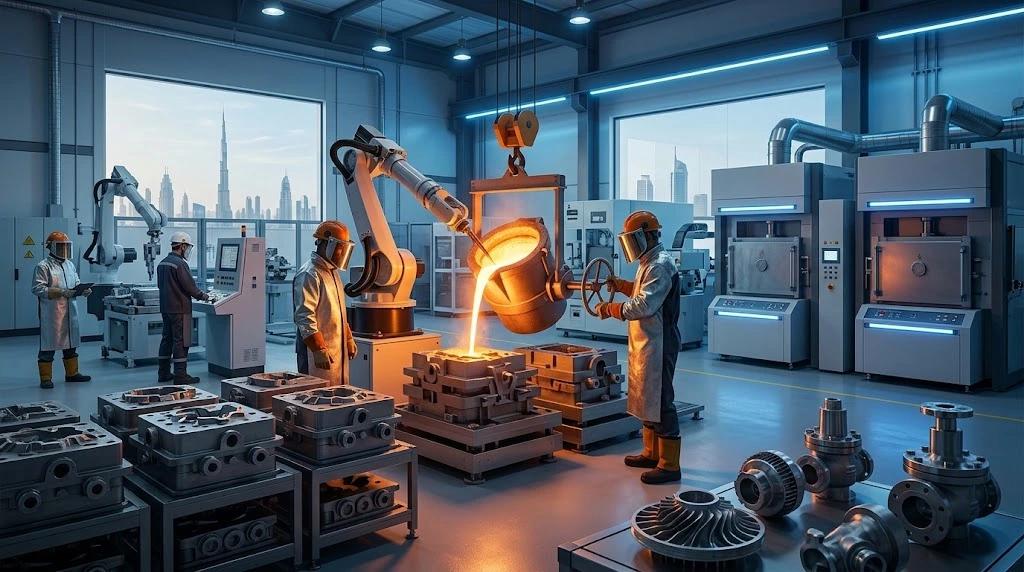
Metal casting involves pouring molten metal into a mold and allowing it to cool and solidify into the required shape. With the right equipment, technical knowledge, and quality control procedures, casting can produce components suitable for demanding industrial applications.
A professional casting company can offer several material and manufacturing options, including sand casting, cast iron casting, aluminum casting, brass casting, bronze casting, and lead casting. Additional machining services such as lathe works can further improve the accuracy and finish of cast components.
What Makes Metal Casting Important?
Many industrial components have complex shapes that can be difficult or costly to manufacture entirely through conventional machining. Casting makes it possible to produce intricate shapes while offering flexibility in material selection and component size.
The right casting process depends on several factors, including the type of metal, component design, required dimensions, production quantity, and final application. Experienced manufacturers can evaluate these requirements and recommend a suitable approach.
For businesses in Dubai, working with a capable metal manufacturer can simplify the production process. Instead of managing separate suppliers for casting and machining, companies can obtain multiple manufacturing services from one experienced provider.
Sand Casting for Versatile Production
Sand casting ranks among the most widely used metal casting methods. Manufacturers create a mold from specialized sand and then pour molten metal into the mold cavity to form the required component.
One of the key advantages of sand casting is its flexibility. Manufacturers use sand casting to produce components in different sizes and shapes while working with a wide variety of metals. This makes the process useful for industrial machinery, engineering components, replacement parts, and customized products.
Sand casting can also be a practical option for producing components with relatively complex geometries. After casting, additional machining or finishing can be performed to achieve the required specifications.
Cast Iron Casting for Heavy-Duty Components
Manufacturers commonly choose cast iron casting for applications that require durability, strength, and wear resistance. Industries use cast iron to produce machinery components, equipment housings, industrial parts, structural components, and replacement products.
The casting process allows manufacturers to create robust components in shapes that may be difficult to produce using machining alone. Once manufacturers produce the casting, they can use precision machining to achieve accurate dimensions and functional surfaces.
For demanding applications, choosing the appropriate cast iron material and production method is essential. A knowledgeable casting provider can help ensure that the manufacturing process matches the component’s intended operating conditions.
Aluminum Casting for Lightweight Components
Manufacturers choose aluminum casting when applications require lightweight components and good corrosion resistance. Aluminum combines low weight with useful strength and versatility, making it suitable for a wide range of industrial applications.
These characteristics make aluminum casting a practical choice for various industrial and engineering applications. Manufacturers use aluminum casting to produce machinery components, equipment parts, construction products, and customized metal components.
Manufacturers can add precision machining after the casting stage to achieve tighter dimensional tolerances, accurate holes and threads, and smooth finished surfaces.
Brass Casting for Reliable Engineering Applications
Manufacturers value brass casting for its machinability, corrosion resistance, and versatility. Industries use brass components for fittings, valves, mechanical parts, hardware, and specialized industrial products. The casting process allows manufacturers to create customized brass components according to drawings and specifications. Manufacturers can perform additional machining and finishing based on the final application to achieve the required dimensions, surface quality, and overall finish.
For companies requiring durable and accurately manufactured brass components, professional casting expertise can help improve consistency and product quality.
Bronze Casting for Marine and Industrial Uses
Bronze casting is particularly useful in applications where durability, wear resistance, and corrosion resistance are important. Bronze has a long history of use in engineering and marine-related components.
It can be used for bushings, bearings, fittings, specialized machinery parts, and other components exposed to demanding operating environments.
The material’s characteristics can make bronze especially useful for certain marine services, where components may be exposed to moisture and corrosive conditions. Selecting the correct bronze composition depends on the specific application and required performance.
Lead Casting for Specialized Requirements
Lead casting serves specialized industrial purposes where the unique characteristics of lead are beneficial. Its high density and other material properties can make it suitable for specific customized components and applications.
Because lead requires careful handling and appropriate manufacturing practices, professional casting facilities should be used for producing lead components. Specifications, dimensions, and intended use should be clearly communicated before production begins.
Lathe Machines for Precision Finishing
Casting often produces the basic shape of a component, but many parts require additional machining before they are ready for installation or use. Lathe machines are important tools for achieving precision in cylindrical and rotational components.
Lathe operations can include turning, facing, boring, drilling, threading, and other machining processes. These operations remove excess material and create accurate dimensions and surfaces.
Professional lathe works can therefore complement casting services by transforming cast components into finished engineering parts. Combining both capabilities can save time and make production coordination easier for customers.
Marine Services and Metal Manufacturing
Dubai’s strong maritime and industrial sectors create ongoing demand for reliable metal components and marine services. Marine equipment often operates in challenging environments, making material selection and manufacturing quality particularly important.
Cast metals such as bronze and brass can be considered for certain marine components because of their useful corrosion-resistant properties. Other materials may be appropriate depending on the component’s design, operating environment, and performance requirements.
Manufacturers offering casting alongside machining capabilities can support customized marine components, replacement parts, and specialized engineering requirements.
Choosing the Right Casting Company
Selecting the right casting company is an important decision for businesses that depend on consistent component quality. Before choosing a supplier, customers should consider manufacturing experience, available casting processes, material capabilities, machining facilities, quality control, customization options, and production capacity.
A reliable manufacturer should be able to understand technical drawings and specifications while providing practical guidance about materials and manufacturing processes.
It is also beneficial to choose a supplier capable of handling both casting and machining. This can reduce the complexity of managing multiple vendors and help maintain consistency from the initial casting stage through final finishing.
Why Choose Metal Casting Services in Dubai?
Choosing professional metal casting services in Dubai gives businesses access to manufacturing solutions suited to a wide range of industrial requirements. Local manufacturing can also make communication, customization, production coordination, and project management more convenient.
Whether the requirement involves aluminum components for lightweight applications, cast iron parts for heavy-duty equipment, brass and bronze components for specialized uses, or customized sand castings, the manufacturing process should always be selected according to the project’s technical requirements.
With additional lathe works and machining capabilities, cast components can be accurately finished and prepared for their intended applications.